

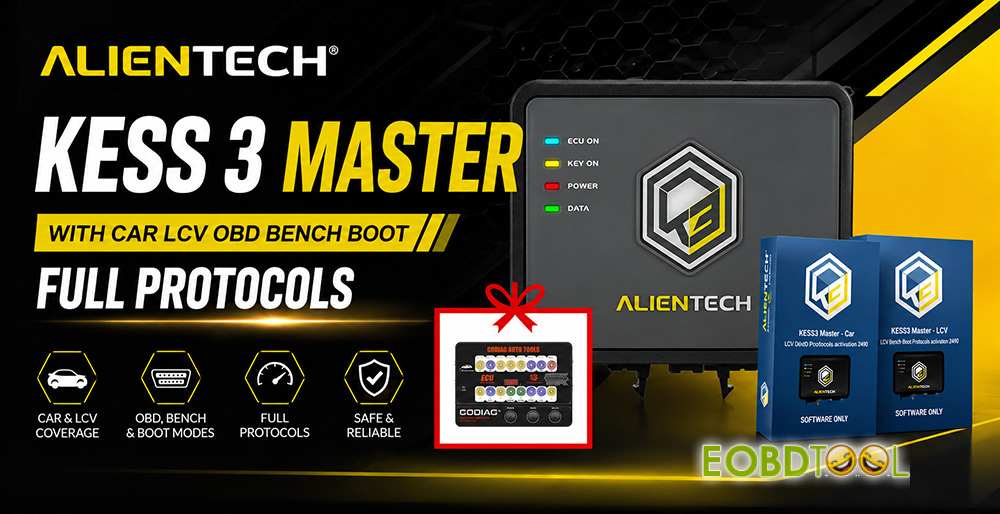
This FAQ guide outlines the diagnostic, data logging, and performance testing capabilities of Alientech KESS3 ECU Programmer. Learn how built-in features like Alientech Suite DTC clearing, real-time DataLogger parameter tracking, and DynoDrive road testing streamline ECU remapping workflows under an active subscription.
Q1: Can I clear error codes with Kess3?
A: Yes. Where supported, you can reset DTCs directly from the Suite, without using external tools for this operation.
Q2: Can I compare multiple recordings with each other?
A: Yes. Saved logs can be analyzed and compared to check differences between configurations, modifications or vehicle operating conditions.
Q3: Can I generate a PDF for the customer?
A: Yes: you can generate PDFs, also customizable with logo and header.
Q4: Can I measure performance after the modification?
A: Yes. With DynoDrive, you can measure torque, power and acceleration directly on the road.
Q5: Can I monitor engine parameters in real time?
A: Yes. With DataLogger, you can view and record parameters such as pressure, temperature, engine speed and other values returned by the ECU.
Q6: Can I read and clear error codes?
A: Yes. The DTC function is included in the subscription.
Q7: Can I record data while driving the vehicle?
A: Yes. Datalogging can be performed both in the workshop and on the road, allowing you to analyze engine behavior in real operating conditions.
Q8: Can I run 0-100, 60-130 and 1/4 mile tests?
A: Yes, Kess3 with DynoDrive measures acceleration tests on the most requested metrics, also with configurable distances and speeds.
Q9: Do I need a long, perfectly flat road?
A: For power/torque measurement, good conditions help: straight and as flat as possible. If you do not have them, acceleration mode is often much easier to manage.
Q10: Do I need to be connected to the internet to record data?
A: No. You can perform datalogging even offline. The data is saved and can be consulted or exported later.
Q11: Do special functions replace a complete diagnostic tool?
A: No. Special Functions integrate the work with KESS V3 and allow you to perform specific operations. For fault-code diagnosis, use the DTC function, and to understand how the vehicle really behaves, use the DataLogger function: all these functions are included in KESS3 subscription.
Q12: Does Kess3 perform full diagnostics?
A: No. It does not replace a multi-brand diagnostic tester. It is focused on remapping.
However, it allows you to read and clear engine control unit DTCs.
Q13: Does the DTC function replace a complete diagnostic tool?
A: No. The DTC function integrates Alientech Kess3 workflow, allowing you to read and clear error codes quickly and easily. Dedicated diagnostic tools may be required for in-depth diagnostics.
Q14: Does the function have an activation cost?
A: No, it is always available on all KESS3 units with an active subscription.
Q15: Is datalogging useful even after recalibration?
A: Absolutely. Datalogging allows you to verify engine behavior after a modification in a concrete way and check that all parameters are working correctly.
Q16: Is it as accurate as a rolling road dyno?
A: A dyno is a controlled environment. On the road, there are variables. DynoDrive is not designed to replace a dyno: it is designed to measure and document performance on the road in a credible and repeatable way.
Q17: Is the recorded data saved automatically?
A: Yes. Each datalog session can be saved and archived for future consultation.
Q18: What can I do with the DTC function?
A: You can read and reset error codes directly from Alientech Suite, with a fast and guided process. It is a useful function to check the vehicle status before and after each intervention.
Q19: Where does the test data go?
A: In the Alientech Cloud, inside your DynoDrive section in Dashboard, with history and analysis tools.
Q20: Which parameters can I monitor?
A: You can view and record the main ECU parameters in real time, such as engine RPM, turbo pressure, fuel quantity, temperatures, engine load and many other values available in the control unit.
Q21: Why should I read DTCs before a recaliration?
A: Reading DTCs before working on the vehicle lets you check whether anomalies are already present. This gives you more control and helps you distinguish pre-existing issues from those that may appear after the intervention.
Read also:
- Alientech Kess3 Update Datalogger: Real-Time ECU Parameters Monitor (March 23, 2026)
Alientech Kess3 Update Datalogger: Real-Time ECU Parameters Monitor
- How to Activate and Use Alientech KESS V3 DynoDrive Function?
How to Activate and Use Alientech KESS V3 DynoDrive Function?