


Question:
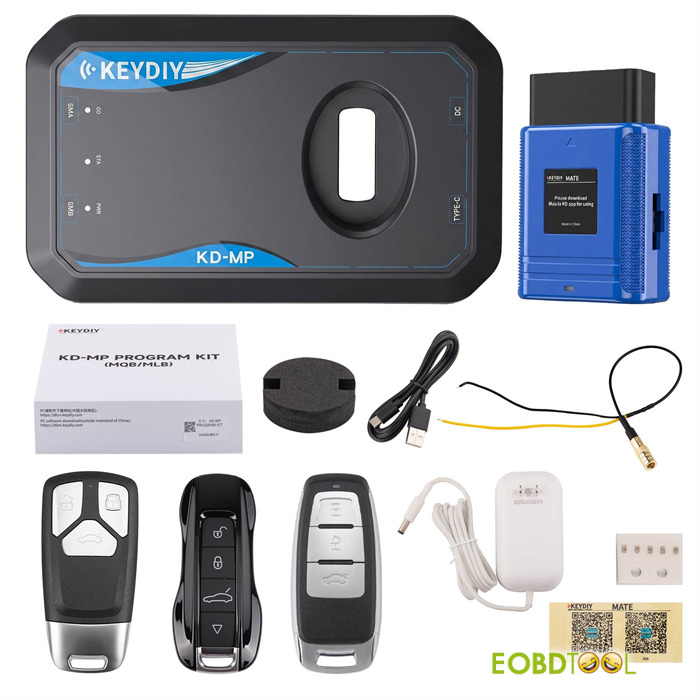
Is it possible to recognize cloned keys as factory- original ones on modern MQBs using KEYDIY KD-MP 5-in-1 Programmer Kit?
Answer:
Absolutely. Even the advanced rolling code verifications typically found in high-end German security systems (such as BMW) pass without a hitch.
To prove this, let’s look at a real-world case. Last week, one customer brought in a 2021 Volkswagen Atlas SEL. He had accidentally dropped his primary remote near a pool deck, and water instantly fried the internal circuitry. Even though he had a properly cut spare mechanical blade, the engine refused to start without the transponder data. Facing an $800+ bill from the dealership, he asked if we could clone his remaining functional key onto an affordable aftermarket fob he bought online.
Most technicians assume that cloning a key on 2019+ model year vehicles is impossible due to modern security protocols. However, with KD-MP, that assumption is entirely wrong.
The Step-by-Step Cloning Process
The process requires strict attention to detail and deep cryptographic alignment. Here is exactly how the successful clone was executed:
1.Pre-Diagnostic Check
Before jumping into copy mode, it is vital to understand what you are working with. Using KD-MATE linked to the vehicle’s OBD2 port, navigate to:
Advanced Diagnostics > Immobilizer Security Level Check
For this Atlas, the live data confirmed the master key was operating under AES-128 encryption. Standard bit-flipping methods won’t work here; you must mirror the exact cryptographic signatures recognized by the vehicle’s immobilizer control unit (BCM/Dashboard).
2.Back Up Original Data
Boot up KEYDIY KD-MP Tool, connect it to laptop, and open the software.
Select Key Cloning Mode and choose the correct option (Audi VW MQB Gen3).
Insert the working OEM key into the ignition (or hold it against the emergency start slot on the steering column) while initiating a passive authentication trigger via the software.
The software will display a live hex dump showing the security handshake generated by the Engine Control Module (ECM).
KD-MP tool will capture the entire memory block segment containing the seed values, counter states, and session salts, saving them to a temporary buffer.
3.Write to New Transponder
Take a brand-new, unprogrammed MQB-compatible RF transmitter (ensuring it matches the correct frequency, such as 433.92MHz or 315MHz depending on the region).
Place the new key flat onto KEYDIY KD-MP antenna coil pad and hit START COPY.
The progress bar will move slowly, particularly as it verifies data past the 98% mark. The entire write process takes precisely 1 minute and 17 seconds.
4.Test and Verify
Once completed, the new key was brought to the vehicle. Upon testing the remote functions—lock, unlock, and trunk release—the response was instant and flawless. The real test came next: inserting the key and pressing the Start button. The engine fired up perfectly on the very first attempt, with no dashboard security errors.
Why KD-MP Succeeds?
Unlike budget, knockoff programmers that claim “universal compatibility” by trying to fake responses, KEYDIY KD-MP 5-in-1 Tool accurately replicates the exact crypto-authentication chains embedded within modern VAG Continental/Bosch MEVD17.x controllers.
Most low-end transponder tools crash or trigger permanent vehicle lockouts because they cannot bypass three critical defensive layers:
- Symmetric Encryption Handshake Protocol
Modern MQB immobilizers use a strict bidirectional handshake. The car sends a random, one-time secret value X to the key. The key must use its internal secret key Y=H (X||K_secret to calculate and return the correct response K. Without knowing or perfectly cloning that secret K, authentication fails immediately—no matter how strong your raw radio signal is.
- Component Security (CS) & Batch Hash Validation
Authorized keys must align with specific production signatures registered in the vehicle’s central gateway. If a cloning tool attempts to force a copy without injecting a valid signature derived from OEM data structures, it will trigger an irrecoverable immobilizer fault code (such as P16C0 – Key Incorrect), permanently disabling further programming attempts until a hard reset is performed.
- UDS Firmware Anti-Tamper Flags
Starting around 2020, Volkswagen introduced aggressive anti-tamper flags within the UDS (Unified Diagnostic Services) protocol (specifically under the DTC 0x1Fxx series). These flags look for unauthorized flash modifications or out-of-sync rolling codes. Low-end readers completely ignore these flags; the key might look like it programmed successfully in the shop, only to trigger a “No Key Detected” failure during the very next cold start.
The Final Verdict
After completing the procedure on the Atlas, a full system diagnostic scan was performed using VCDS.
Zero pending faults across all immobilizer, dashboard, and engine control modules. The customer drove away incredibly relieved, having spent less than half of what the dealership quoted.
Since this successful job, this exact protocol has been replicated on seven other modern MQB-platform vehicles (including Volkswagen T-Rocs and Arteons). All of them later passed manufacturer-level validation checks at certified workshops whose technicians initially claimed it couldn’t be done.
Read also: